Motoko Otsuki
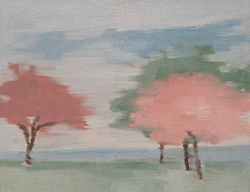
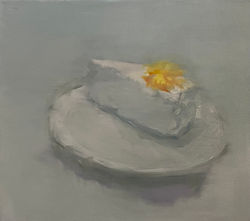
Motoko Otsuki is a painter working primarily in oil, whose practice draws from fragments of everyday life—meals, interiors, street corners, and fleeting landscapes glimpsed in transit. Using snapshot photographs taken by herself or others as points of departure, she reconfigures partial views and incidental details into compositions that resist clear narrative resolution. At first glance, her paintings often appear calm, familiar, or quietly congenial. With sustained looking, however, subtle dissonance and emotional instability surface beneath the image. Rather than constructing linear stories, Otsuki is interested in holding moments where meaning remains unresolved, allowing ambiguity and distance to persist. Her work engages with emotional discomfort that lingers beneath society’s seemingly harmonious atmosphere, exploring paradoxical states of being present yet overlooked, seen yet slightly removed. Even within scenes of everyday civilization, her paintings convey a quiet sense of desolation and misalignment that unfolds slowly over time. Motoko Otsuki has exhibited in Japan and the United States, including solo exhibitions at Nihonbashi Mitsukoshi Main Store (Tokyo) and Tiny Dancer Gallery (New York), as well as group exhibitions at NowHere and Thomas VanDyke Gallery, among others. She has also served as a guest lecturer at Tokyo Zokei University and Kyushu Sangyo University. Through painting, Otsuki continues to explore a space prior to resolution—an in-between state where emotional nuance, ambiguity, and quiet tension are allowed to remain.


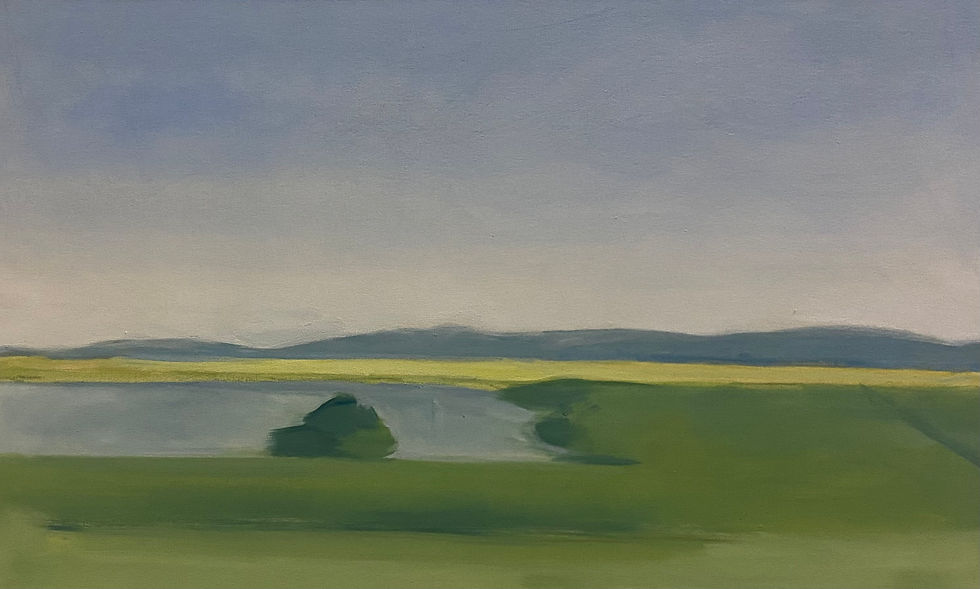
Oil on canvas 22"×36" 2025
Oil on canvas 22"×36" 2025
Motoko Otsuki: Staying With What Does Not Settle
For Otsuki, painting begins not with answers, but with fragments. Working primarily in oil, she draws from the ordinary materials of daily life—photographs taken almost without intention, moments glimpsed in passing, partial views that resist cohesion. These images are not treated as fixed references, but as unstable sources: cropped, rearranged, and quietly interspersed across the canvas. What emerges is not a story to be followed, but a space to linger within. Her path toward becoming an artist unfolded gradually. Drawing had always been present in her life, but it was during preparation for art school that art first appeared as a possible direction. After graduating, being approached by a gallery helped situate that direction more clearly—transforming inclination into commitment.
One of the most persistent challenges in her practice, however, was not technical, but linguistic. For a long time, Otsuki struggled to write about her work. Each attempt at an artist statement felt slightly misaligned with what the paintings were doing. Rather than resolving this tension through language alone, she moved back and forth between writing and making—allowing each process to test and clarify the other.
“When words fell short,” she reflects, “I returned to drawing and painting.”
Keeping her hands moving became essential. Through sustained making, understanding slowly deepened. Over time, she came to recognize that this unresolved state—the difficulty of articulation, the feeling of distance—was not a problem to be solved, but something fundamental to her work. Ambiguity, dissonance, and emotional instability were not obstacles; they were the ground itself. This sensibility extends to how she defines achievement. Rather than pointing to singular moments of recognition, Otsuki speaks of her ability to return to painting as one of her proudest accomplishments.
 |  |
|---|---|
 |  |
 | 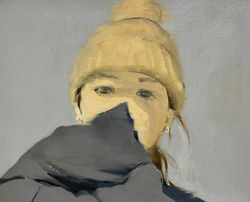 |
Regardless of external circumstances, she continues to come back to drawing and painting—not as an escape, but as a way of staying grounded and moving forward. The act of returning, again and again, has become a quiet form of resilience. Her work has always been closely tied to everyday life, and that connection has deepened over time. Emotional experiences subtly register in her paintings—sadness darkening backgrounds, encounters with new people prompting portraits. Recently, she has begun writing short, diary-like texts alongside her practice. These notes are not formal statements, but gentle traces of daily experience, allowing her to observe how small moments gradually become reasons to paint.
At the same time, the foundation of her work has remained unchanged: a vague, unsettled emotional state that arises from moments that feel slightly off. Rather than clarifying these sensations, she seeks to present them as they are. In recent years, this has led her toward greater restraint. She has become increasingly attentive to what not to paint—simplifying her images, removing rather than adding, and allowing omission and space to play a more active role. Reduction, for her, is a way of staying close to uncertainty.
When reflecting on setbacks, she returns again to the tension between painting and explanation. Trying too hard to articulate her work has, at times, created distance from the act of making itself. Moving between language and paint has become a way to recalibrate—testing direction, then returning to the studio with renewed clarity. Through experience, Otsuki has also learned the importance of selection. Surrounded by advice, information, and expectation, she has found that choosing what truly supports her practice—and setting aside what does not—is essential. Trusting that discernment has allowed her to remain grounded and honest in her work. While she values the perspectives of galleries, collectors, and audiences as meaningful points of reference, the studio remains a private space of necessity. Time alone with the painting is where decisions are made from within the work itself. This balance—between openness to dialogue and devotion to solitude—allows her to stay true to her vision.
Her inspirations include artists and writers such as Virginia Woolf, Giorgio Morandi, Les Nabis, and **Edward Hopper—**figures whose work shares an attentiveness to quiet moments, everyday life, and subtle emotional tension. Rather than direct influence, they offer ways of thinking about distance, ambiguity, and restraint that continue to resonate.
When asked what advice she would offer emerging artists facing uncertainty, her response is simple: keep doing it. Uncertainty, she believes, does not signal failure. Often, continuing to work is the only way through.
Today, success is defined less by resolution than by sustainability—maintaining the inner conditions that allow the work to continue, while also supporting life through artistic practice. For Otsuki, both are essential. Together, they make it possible to remain focused, committed, and quietly attentive to what has not yet settled. Through her paintings, she invites viewers into this unresolved space—where images hover, meanings slip, and ambiguity is not something to be solved, but something to remain with.