The Quiet Weight of Colour

Interview with Candise Wai
Candise Wai (also known as Pong Wa Wai) is a contemporary abstract expressionist artist based in Oxfordshire, UK. Born in Hainan and raised in Hong Kong, she creates colour driven works that explore inner peace, resilience, dual belonging, and transformation. An artist since childhood, Wai’s language of colour evolved through a lifetime of layered experiences as a scholar, international analyst, mother, and now a professional artist. She refined her visual language through decades of private practice alongside a 25 year international career in market research and data analytics, a dual path that deepened her sensitivity to perception, emotional nuance, and the unspoken rhythms of lived experience.
Since sharing her work publicly in 2025, her voice has emerged fully formed, quickly gaining international recognition through curated exhibitions in London, Paris, New York, Milan, Madrid, Osaka, Oxford, Athens, and beyond. Her work has also been featured in publications, awards, large scale digital billboard showcases, and a solo online exhibition with a New York gallery. Her mature expression reflects a lifetime’s preparation behind every brushstroke, guided by intuition, reflection, and a deep trust in colour as truth.

Your work often explores memory, identity, migration, and belonging. How have these themes evolved throughout your artistic journey, and what do they mean to you today?
Migration and my international career have widened my sense of the world in ways that continue to shape my art. Living and working across cultures taught me that human experience is deeply connected, even when our languages, histories, and traditions differ. Over time, these encounters softened my understanding of identity and belonging. I learned to appreciate the beauty of each place, its rhythm, its culture, its emotional atmosphere, and to feel connected even in unfamiliar environments.
Memory, identity, and belonging no longer feel like fixed concepts; they feel fluid, shaped by movement and openness. Through painting, I express this emotional continuity. Colour becomes the bridge between places, and abstraction becomes the language through which I carry my experiences into new contexts. In every work, I try to honour the idea that we can find connection anywhere, that art allows us to feel at home even when we are far from where we began.
Colour has a particularly strong presence in your paintings. What does colour allow you to express that words or other visual elements cannot?
I have been an artist all my life, for many years my practice was private. I painted quietly, for myself, as a way to understand my inner world. Sharing my work publicly only happened in recent years, and it changed something profound in me. When viewers told me they felt moved by my paintings, I experienced an unexpected sense of connection, a recognition that the emotions I translate through colour can resonate deeply with others.
I am fascinated by the power of colour as a universal language. It speaks directly to the mind and heart without needing explanation. People can sense sincerity; they can feel when a painting comes from a true place. That honesty creates a bridge between my inner experience and theirs. In those moments, I am reminded that art is not only a personal expression; it is a shared emotional space where human connection becomes possible, even across different cultures and life stories.
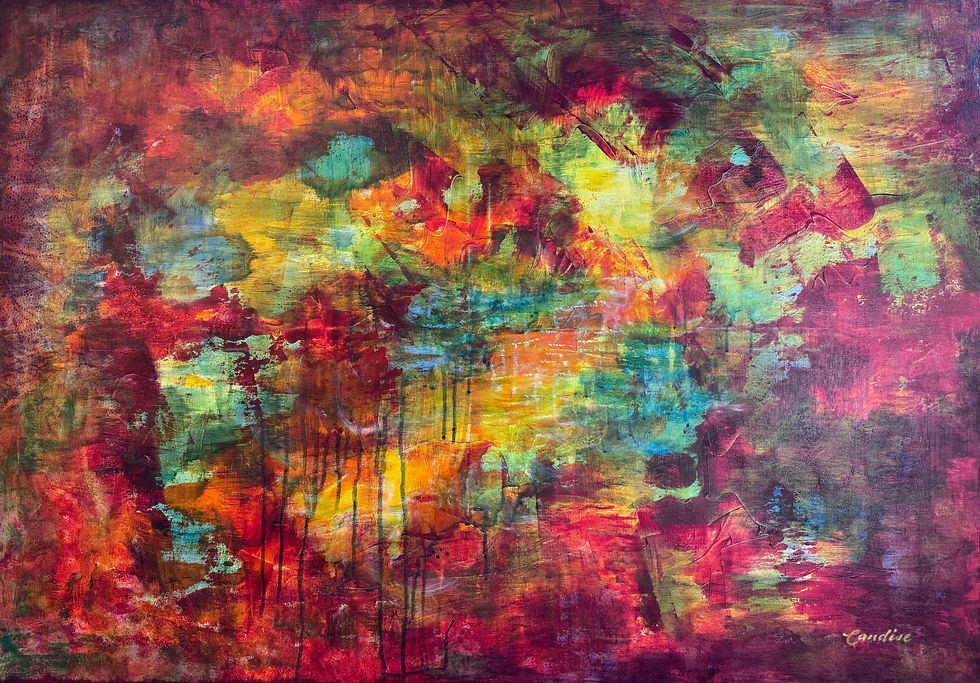
Your experience growing up in Hong Kong, surrounded by different cultural influences, seems to have shaped your understanding of identity. How does this cultural convergence find its way into your work?
I feel blessed to have grown up in a place where the East meets the West so naturally. Hong Kong’s cultural landscape is shaped by generations of migrants from across China and a vibrant international community. From a young age, I was surrounded by the richness of Chinese traditions, the proximity of other Asian cultures, and the influence of Western ideas and aesthetics. This convergence formed my instinctive openness, a way of seeing beauty in many directions at once. These multiple artistic influences have always fascinated me. They taught me to stay curious, to remain clear minded, and to find balance even amid complexity. My art reflects this layered upbringing: colours that carry both softness and intensity, compositions that hold movement and stillness, and abstractions that feel rooted in more than one cultural rhythm. The convergence I grew up with continues to shape my identity, and it quietly lives inside every painting I create.
When you begin a new painting, where does the process usually start with an emotion, a memory, an image, a colour, or something else?
When I begin a new painting, the starting point is never fixed. Sometimes I arrive with a clear intention; other times I begin with nothing more than a feeling. The impulse can come from an emotion, a memory, a scene, or simply a colour that appears in my mind, shaped by my personal experiences and the world around me, society, people, and the quiet moments of daily life.
My process is a blend of intention, intuition, and spontaneity. I allow the work to unfold in ways I cannot fully predict. That unpredictability is essential; it creates layers of meaning and beauty that I could never plan. In many ways, I paint my subconscious mind. The canvas becomes a space where inner movement takes form before I fully understand it.
People often tell me that viewing my art feels like listening to music, something emotional, atmospheric, and open to interpretation. That is exactly how the process feels to me as well, a rhythm guided by instinct, a composition shaped by both clarity and surrender.
There is often a sense of both movement and stillness in your work. How do you approach creating that balance, and what do you hope the viewer feels when encountering your paintings?
Movement and stillness have become a signature rhythm in my paintings, though I only truly recognise it after the work is finished, when I step back and view it as a viewer rather than a creator. I am naturally drawn to the vitality and movement of modern life and nature, yet I instinctively balance that energy with stillness. Without that balance, the complexity of our world can feel overwhelming.
We all live in a time of unpredictable speed and constant noise. This undercurrent exists across cultures; it is part of the emotional landscape of contemporary life. I feel that my paintings respond to this sensation, they navigate complexity with calm, offering a space where movement and stillness can coexist without conflict. Through colour, rhythm, and atmosphere, I try to express a way of staying positive, peaceful, and grounded in a fast moving world. The beauty, for me, lies in the interaction between these forces, the vitality that keeps us alive, and the stillness that keeps us sane.

How has your relationship with abstraction developed over time? Has there been a particular moment when you realized that abstraction could become your most natural visual language?
I have been making art since I was a little girl, naturally drawing and experimenting with any art materials I could use. When I became a teenager, I painted more realistically, still life, portraits, detailed studies, while also exploring experimental art projects. Those early years trained my eyes to observe closely and built a strong technical foundation. I believe that strong technical skills and the ability to truly see as an artist are essential for creating meaningful abstraction.
When I entered my professional career in market research and analytics, I began to feel a growing need to paint more intuitively. My analytical career was demanding, and art became a balance, a private space where I could express what could not be articulated through language. Abstraction came naturally to me when I felt the need with freer and deeper emotional expression. It felt honest, instinctive, and aligned with how I experience emotion. My earlier self-training made it easy to master the techniques of abstraction. I am fascinated by abstraction’s ability to leave room for interpretation. It allows expression without defining objects too clearly, creating space for atmosphere, feeling, and subconscious movement. To me, that openness is beautiful. It invites both the artist and the viewer to enter the work with sincerity, imagination, and emotional truth.
Your book, The Quiet Weight of Colour, brings together your artistic practice and personal journey. Looking back at the work included in the book, what do you feel it reveals about you that perhaps cannot be understood from a single painting?
Looking back at the works included in The Quiet Weight of Colour, I realise the book reveals something essential about me, that I have always been an artist expressing intuitively through colour. Even though I pursued an analytical career for more than two decades, that experience became part of my artistic language. I have always believed that artists need rich life experiences to create work that truly connects, and my journey across cultures, disciplines, and emotional landscapes has shaped the depth of my abstraction.
The book begins with paintings from my 2-year relocation from Hong Kong to Shanghai in my early professional career, a period when I painted extensively while navigating a demanding professional assignment. Those works show the early seeds of my move toward abstraction, moments where intuition began to take precedence over representation. The book then shares my painting created in 2025–2026, more than twenty years later, and that creates an interesting dialogue across time. You can see how my abstraction has evolved, the gestures have become more fluent, the compositions more free, yet one thing remains constant. Whenever I paint intuitively, vibrant colours emerge naturally. I think this reflects a positive emotional undercurrent in my work, something rooted in my loving upbringing and the sense of optimism that has stayed with me throughout my life. The book reveals not only the evolution of my visual language, but also the continuity of my inner world, a lifelong commitment to expressing emotion, memory, and resilience through colour.

Artists often change through life experiences, even when their visual language remains recognizable. What experiences have most influenced the artist you are today?
Growing up in Hong Kong meant living within a mosaic of cultural influences, Chinese heritage, international communities, and the constant movement of people and ideas. That environment shaped my openness from an early age. A formative chapter was becoming a Swire Scholar at The University of Hong Kong. Residing at Robert Black College, the university’s guest house, living and studying alongside distinguished scholars from around the world expanded my worldview, teaching me to appreciate intellectual diversity and cultural nuance. That foundation prepared me for a global analytical path, helping multinational companies understand markets, behaviour, and complexity. Working across Hong Kong, mainland China, and with expatriates from around the world, while travelling frequently for both work and life, enriched my understanding of human connection. These encounters kept my curiosity alive, encouraged constant learning, and quietly broadened the emotional landscape that informs my art today.
One of the most significant shifts came with my relocation to Oxfordshire of the United Kingdom. The contrast between Hong Kong’s intensity and the quiet rhythm of the English countryside created a new kind of inner space. Here, I found more room to reflect, to breathe, and to paint with greater clarity. The stillness softened my pace and allowed my abstraction to evolve in a more fluid, contemplative direction. All these experiences, cultural convergence, intellectual openness, global exposure, and the gentle quiet of my current home, have shaped the artist I am today. They remind me that art grows through life, and that every place we inhabit leaves a trace on the canvas.
What role do intuition, experimentation, and emotion play in your studio practice? Do you begin with a clear intention, or do you allow the artwork to guide you somewhere unexpected?
When I begin a painting, I start with both intention and experimentation. Sometimes there is a clear idea or emotional direction; other times, I simply begin and allow the work to guide me. Once the first marks are made, I respond to what appears on the canvas, adjusting, expanding, and experimenting based on my mood, intuition, and the evolving intention of the piece.
Control and spontaneity both play essential roles in my process. There is freedom in how the colours move, but also a quiet structure that holds everything together. Viewers may sense a harmonious narrative, even if the story is abstract. My aim is to create a visual rhythm that feels fluid yet balanced, allowing each person to enter the work with their own interpretation while still feeling the coherence beneath it.
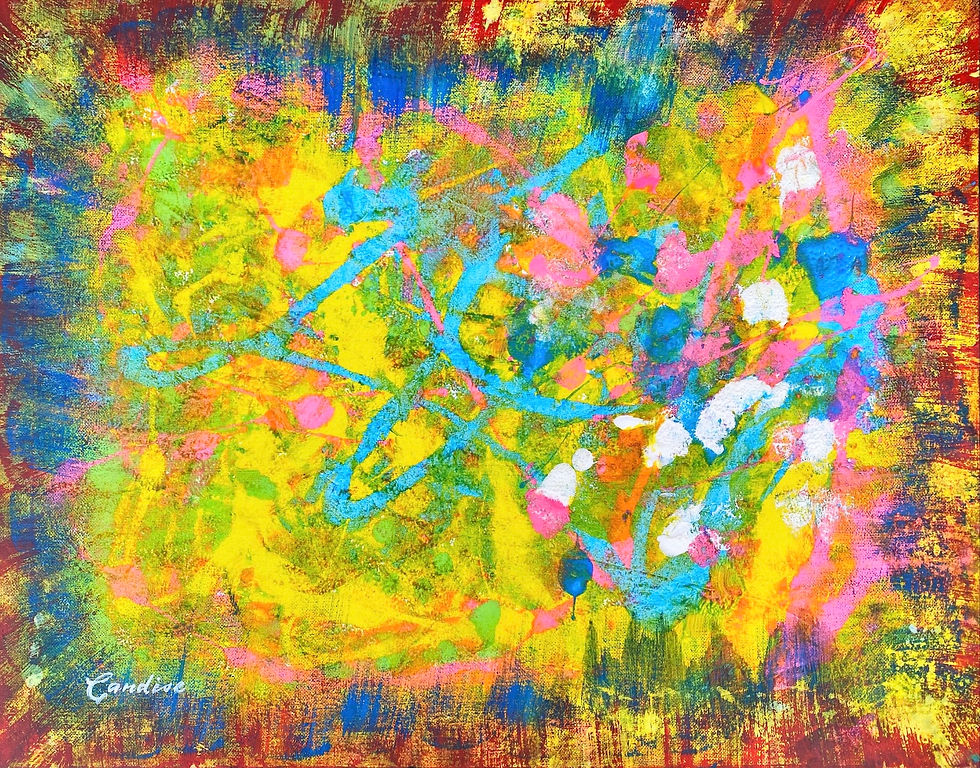
As you look toward this next chapter of your practice and the new edition of your book, what are you curious about exploring next? Is there a direction, question, or feeling that is currently calling you forward?
In the future, I want to explore colour interaction even more deeply, especially how colour can reflect the movement of our minds. In a world filled with noise, speed, and constant distraction, it is increasingly rare for art to make us feel present. Yet colour has the ability to do exactly that. It can quiet the mind, speak directly to our inner landscape, and create a moment of clarity in the midst of modern complexity. There is something quietly enduring in the way my paintings create emotional presence. I try to offer a kind of stillness that feels both intimate and universal, a sincerity that allows viewers to reconnect with themselves. I believe it is part of my artistic legacy, shaped by a lifelong commitment to emotional honesty.
My art is not an escape from reality but a condensation of it. It gathers life’s complexities, its challenges, struggles, rises and falls, and holds them alongside peace, beauty, strength, passion and stillness. Its optimism is earned through courage and resilience.
As I move forward, I want to keep exploring how colours meet, collide, soften, and transform, how these interactions mirror our inner rhythms, tensions, and harmonies. Colour is a universal language. It crosses generations, cultures, and life chapters, allowing people to connect beyond words or circumstance. My hope is that future works will continue to offer a space where viewers can pause, breathe, and feel present in their own minds.


Comments